
Empowerment self-defense training is the only sexual violence prevention strategy with solid evidence of effectiveness at reducing rates of victimization.
The research found that self-defense trained women were “not simply less likely to be raped if attacked…but were less likely to be attacked at all.” 1

College Women in the United States
One year after completing a 30-hour Empowerment Self-Defense course reported:
- 55% decrease in unwanted contact
- 69% decrease in sexual coercion
- 100% decrease in completed rape.2
University Women in Canada
One year after completing a 12-hour ESD program reported:
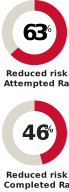
- 63% reduced rate of attempted rape
- 46% reduced risk of completed rape3
Adolescent Girls in Kenya
One year after completing a 12-hour Empowerment Self-Defense course:
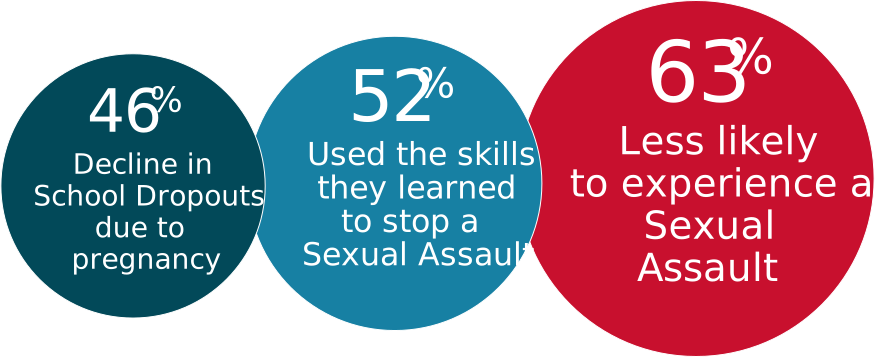
- 46% decline in school dropouts due to pregnancy
- 52% used the skills they learned to stop a sexual assault
- 63% less likely to experience a sexual assault4
What is Empowerment Self-Defense (ESD)?
ESD is a comprehensive approach to violence prevention and resistance education that emphasizes awareness and assertiveness skills in addition to verbal and physical strategies. All of the strategies are easy to learn and highly effective in preventing or ending an assault. ESD classes are designed to empower women and build their confidence.
– National Women’s Martial Arts Federation (NWMAF)
Infographic designed by Mona MacDonald for the National Women’s Martial Arts Federation (NWMAF). May be shared under Creative Commons BY-ND license
The Evidence Base
The most profound testimony about the transformative power of ESD training is what our students say. They tell us how life-changing ESD training has been for them: they are more able to speak up for themselves, less likely to blame themselves for harassment, abuse, and assault; are more confident and less fearful; know themselves better, trust themselves more, have healthier relationships, and are more able to create the lives they want.
Research backs this up. Several studies have found5Link to footnote that people who have taken an ESD class are more likely to avoid sexual assault if they’re targeted, and less likely to be targeted to begin with.
Studies also show ESD training decreases sexual harassment, sexual coercion, and physical violence. For example, in the year following taking an ESD class:
College women in the U.S. were 37% less likely to experience assault of any kind, and none of those who took the self-defense class reported a sexual assault. 6
College women in Canada who took the class were 46% less likely to be raped, and 63% less likely to experience attempted rape, than those who hadn’t taken the class. 7
Teen girls in Kenya who had taken the class were 63% less likely to experience sexual assault than those who hadn’t taken the class. 8
Participants in a community class (who were much more diverse than the U.S. college groups) were 52% less likely to be sexually assaulted in any way, and 58% less likely to experience unwanted intercourse (rape or sexual coercion) than those who didn’t take the class. 9
Research also shows that ESD programs increase assertiveness, confidence, and self-esteem, and lower fear and anxiety.
Although research on ESD is solid, more is needed. For example, most of it has been done with college students, who tend to be similar in age, race, education, and social class. Research is needed that includes more people who aren’t students, are gender expansive, are BIPOC, and who have disabilities, among other identities.
Learn More About ESD
Footnotes
- 2014 Hollander, Jocelyn A. “Does Self-Defense Training Prevent Sexual Violence Against Women?” Violence Against Women, 20(3):252-269 ↩︎
- Ibid. ↩︎
- Senn et al., 2015 ↩︎
- Sinclair et al., 2013, Sarnquist et al., 2014, 2017 ↩︎
- Jocelyn A. Hollander, “Women’s Self Defense and Sexual Assault Resistance: The State of theField,” Sociology Compass 12, no. 8 (August 2018) ↩︎
- Jocelyn A. Hollander, “Does Self-Defense Training Prevent Sexual Violence Against Women?” Violence Against Women 20, no. 3, (March 2014): 252–69 ↩︎
- Charlene Y. Senn et al., “Efficacy of a Sexual Assault Resistance Program for University Women,” New England Journal of Medicine 372, no. 24 (June 11, 2015),
2326–35 ↩︎ - Jake Sinclair et al., “A Self‐Defense Program Reduces the Incidence of Sexual Assault in Kenyan Adolescent Girls”, Journal of Adolescent Health, 53, no.3 (2013), 374–80 ↩︎
- Hollander, J. A., & Cunningham, J., “Empowerment Self-Defense Training in a Community Population”, Psychology of Women Quarterly, 44(2), 187–202 (2020) ↩︎